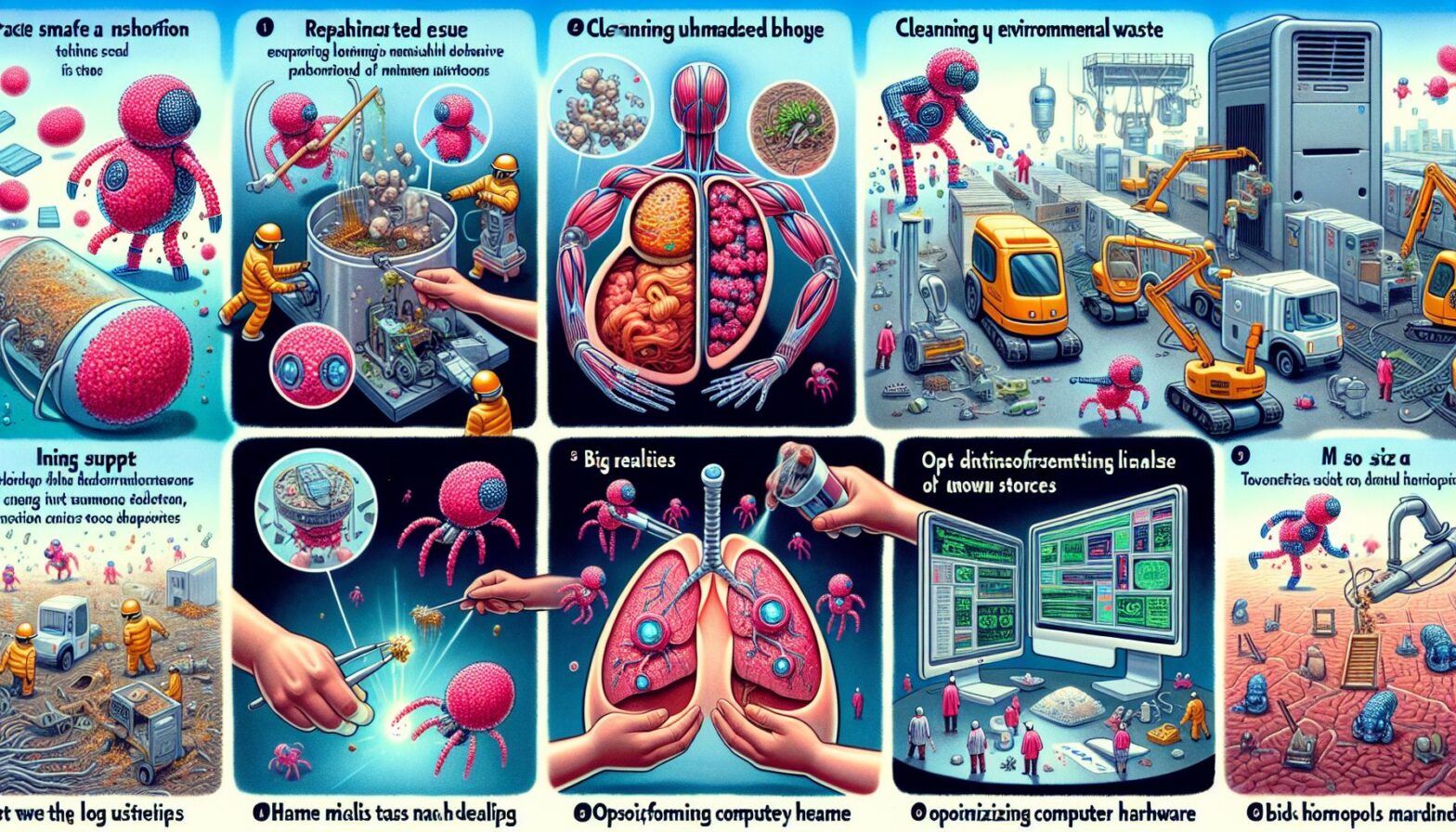
Hey there, fellow tech enthusiasts! I’m thrilled to talk about what was once pure science fiction: nano-robotics. I remember watching those futuristic films as a kid, where tiny bots swarmed inside a spaceship or human body carrying out incredible tasks. Fast-forward to 2023. While we might not have exact replicas of those cinematic wonders buzzing around (yet), the reality of nano-robotics today is mind-blowing and getting smarter by the day.
Nano-What? A Primer
First things first: what exactly are nano-robots? In simplest terms, they’re super tiny robots, usually between 1 to 100 nanometers in size. To put it in perspective, a nanometer is a billionth of a meter. That’s the size of my optimism after reading the latest ICO pitch deck! 🤣 Anyway, these tiny machines are designed to perform specific tasks, often with incredible precision.
Most of their work is invisible to the naked eye. And while we can’t appreciate their hard work with a pat on the back due to distance and scale, I’m sure they know we care. Today’s nano-robots are making breakthroughs in fields we thought they could never reach: medicine, environmental cleanup, data storage, and electronics.
Nano in Medicine: Saving Lives from the Inside
Probably the most exciting area for nano-robotics is medicine. You ever wish a mini plumber could just go into your body and fix that unwanted clog? That’s kind of what we’re talking about here, except it’s more like tiny programmable robots traveling through your bloodstream carrying medicine to fight diseases.
Researchers are working on nano-robots that deliver drugs to specific targets. Imagine a reliable pizza delivery guy but smaller, faster, and without the attitude! These little machines can minimize side effects by focusing directly where treatment is needed rather than spreading it throughout the body. In cancer treatment, precision matters, and nano-robots allow just that. They can home in on tumors with surgical accuracy that would make a sniper jealous.
Some groups are even exploring “swarm” mechanics with these mini-engineers, letting hundreds or thousands of them work together to fight diseases inside patients. It’s like the Avengers, but scaled down in both dramatic speeches and actual size!
Environmental Saviors
Remember those documentaries about massive oil spills destroying our beaches? Enter nano-robots, a solution with serious potential for environmental cleanup. Okay, that was a bit dramatic, but hear me out!
Research shows promise in using customizable nano-particles to capture and break down pollutants into less harmful substances. Think of them as tiny eco-warriors working across ecosystems without any of the dramatic music or slow-motion sequences.
This technology could help nano-robots identify and target things like oil spills for cleanup operations. They could work at the molecular level to break apart contamination that traditional methods struggle with. It’s early days, but the potential applications for water purification and soil remediation look promising.
Real-World Hurdles and Plot Twists
Here’s where reality crashes the party. Building tiny robots hasn’t meant instant breakthroughs overnight, despite what science fiction promised us.
There are genuine technical challenges pushing researchers to their limits. Cost-effective large-scale manufacturing is a major headache. How do you mass-produce something you can barely see? Then there’s the power issue. These robots need energy to function, but cramming a battery into something smaller than a virus isn’t exactly straightforward. Programming them is another nightmare. Writing code for traditional computers is hard enough, but programming molecular machines requires rethinking everything we know about software.
Safety concerns keep me up at night too. What happens if these things malfunction inside a human body? How do we turn them off or remove them? The regulatory approval process for medical nano-robots will probably take years, and rightfully so. We’re talking about putting foreign objects smaller than bacteria into people’s bodies.
What’s Actually Happening Now
Despite the challenges, real progress is happening. Companies like Nanobiosym and research teams at MIT are making actual nano-scale devices that work. They’re not the science fiction swarms we imagined, but they’re functional.
Current nano-robots are mostly simple devices that can perform one or two basic functions. Some can change shape when heated. Others can move in response to magnetic fields. It’s not exactly Iron Man technology, but it’s a start. The medical applications are probably 10-15 years away from mainstream use, assuming everything goes perfectly. Environmental applications might come sooner since the safety requirements are less strict than putting robots inside human bodies.
Whether these mini-machines will live up to the hype remains to be seen. But honestly? Even if they only achieve half of what researchers promise, we’re looking at some pretty incredible possibilities for medicine and environmental cleanup. The future might not have robot swarms fixing everything, but it might have something even better: tiny, precise tools that actually work.