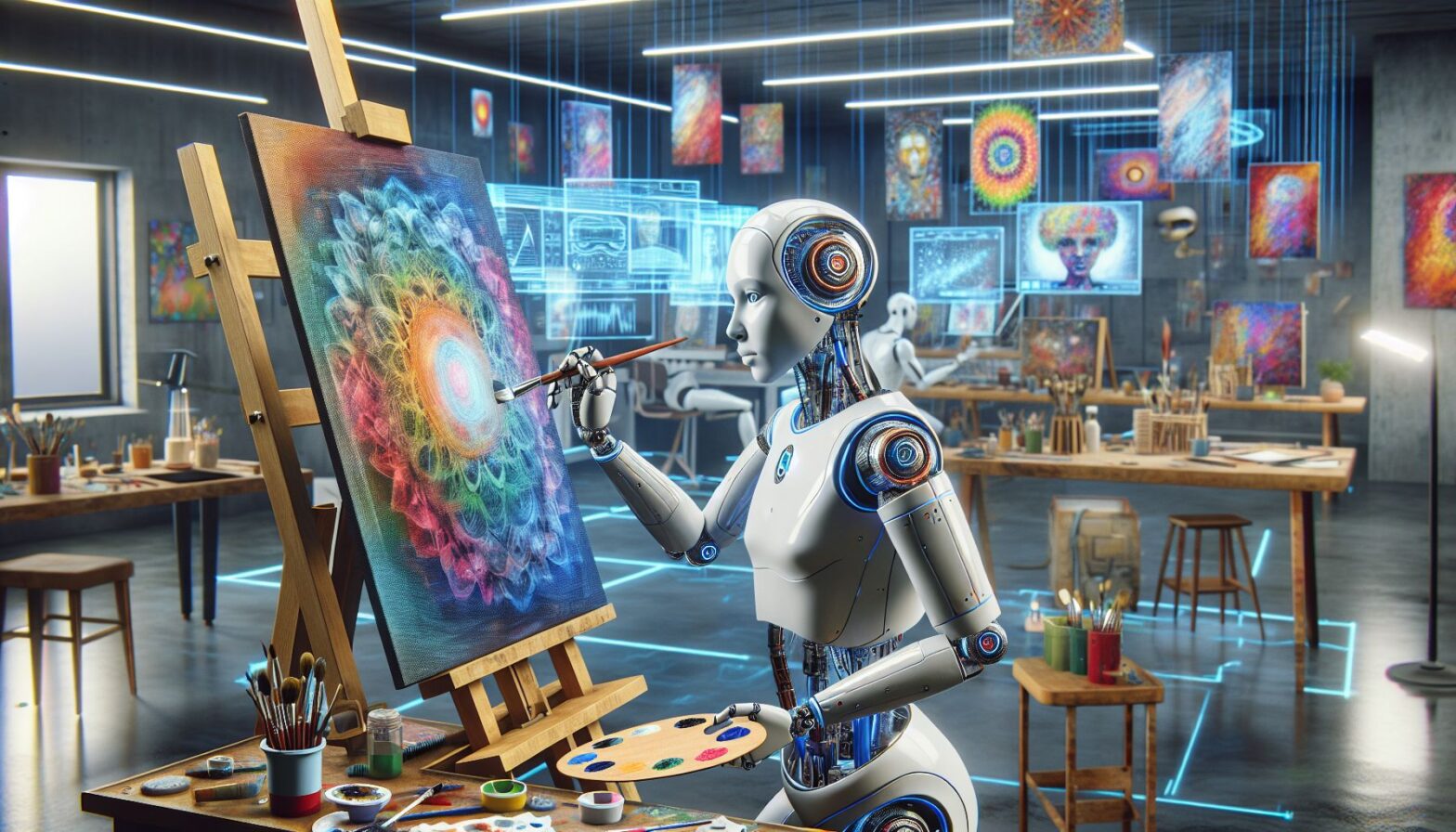
Hey fellow tech enthusiasts! Have you ever glanced at a painting, a piece of music, or an epic sci-fi movie and thought, “Someday, robots will be creating things like this”? Well, that someday is today, and it’s as cool, confusing, and controversial as you’d imagine.
Artificial Intelligence, the most talked-about sibling at the tech family dinner, is literally drawing its own path into the world of creative arts. It’s a playground now open to our silicon-based pals who historically only got to mess around with code and mathematical models. From writing music to painting portraits better than a five-year-old with a finger-paint set (I couldn’t resist!), the possibilities seem endless. Pull up a chair, and let’s explore what this robotic renaissance means for creators, consumers, and cultural critics alike.
The Art Bot Revolution
AI Brushes the Canvas: Algorithms in Visual Arts
Picture this. You walk into a contemporary art gallery, scanning bold canvases hanging in silent anticipation. What if I told you half of those works were created not by an enigmatic artist in a crowded studio, but by code humming softly behind a laptop screen?
That’s exactly what’s happening as generative adversarial networks (GANs) work their artistic magic. OpenAI’s DALL-E, that daily efficiency chip burner, or Google’s DeepDream, known for its psychedelic escapades, aren’t just spewing randomness. Their pieces evoke reflection and provoke discourse like any famed human painter would. Venture capitalists are investing, auction houses are debating, and I’m still trying to wrap my head around how something non-human can aesthetically outsmart the traditionally fancied ‘artist’s eye.’
New Frontiers: AI Writing Tomorrow’s Novels
Writing’s emotive, exploratory playfield poses a unique challenge to AI. One it’s starting to conquer in fascinating ways. The GPT series from OpenAI has shown real capability beyond simple blog posts or assistance prompts. These AI authors are crafting narratives that blur the lines between human and machine creativity.
Sure, AI writing isn’t perfect yet. Sometimes you get sentences that sound like they were translated through five different languages and back again. But when it works? The results can be genuinely surprising. I’ve read AI-generated short stories that made me pause and think, “Wait, a computer wrote this?” The emotional resonance was real, even if the author wasn’t.
What’s particularly interesting is how AI handles different genres. Science fiction seems like a natural fit, but I’ve seen AI tackle everything from romance to mystery with varying degrees of success. The technology is getting better at understanding narrative structure, character development, and even subtlety in dialogue.
Of course, this raises questions about authorship and creativity that we’re still grappling with. When an AI writes a compelling story, who gets the credit? The programmers? The training data? The AI itself? These aren’t just philosophical puzzles anymore, they’re real issues the publishing industry is starting to face.
Rocking AI Composition: Tunes & Beats from the Bots
Music fans, I’ve got news. Your next favorite song might come from an algorithm. AI music generation has exploded in recent years, and some of the results are genuinely impressive.
Take AIVA (Artificial Intelligence Virtual Artist), which composes classical music that could fool most listeners into thinking Beethoven had a secret protégé. Or Amper Music, which lets anyone create custom soundtracks without knowing a single note. These systems analyze thousands of songs to understand patterns in melody, harmony, and rhythm, then create something entirely new.
The technology works differently depending on the style. Some AI composers excel at atmospheric background music, perfect for films or video games. Others are surprisingly good at pop hooks that stick in your head for days. I’ve heard AI-generated jazz that captures the improvisational spirit of the genre better than I expected.
But here’s where it gets really interesting. Musicians are starting to collaborate with AI rather than compete against it. They’ll use AI to generate ideas, then build on them with human creativity and emotion. It’s becoming less about replacement and more about augmentation.
The purists aren’t thrilled, of course. There’s something unsettling about the idea that creativity, our most human trait, can be reduced to algorithms and training data. But maybe that’s missing the point. Maybe AI isn’t replacing human creativity but expanding what’s possible.